It has been called the most famous riddle in Western civilization. Travelers who could not answer it were devoured on the spot. And the answer, once you hear it, makes you see your own life differently.
Table of Contents
ToggleWhat walks on four legs in the morning, two at noon, and three in the evening?
Here is a hint: you have known this creature your entire life. You are this creature. The monster was not asking about something far away.
Click to Reveal the Answer
A Human Being 🧑
Morning is infancy, when a baby crawls on all fours. Noon is adulthood, walking upright on two legs. Evening is old age, leaning on a cane, the third leg.
The Monster at the Gates of Thebes
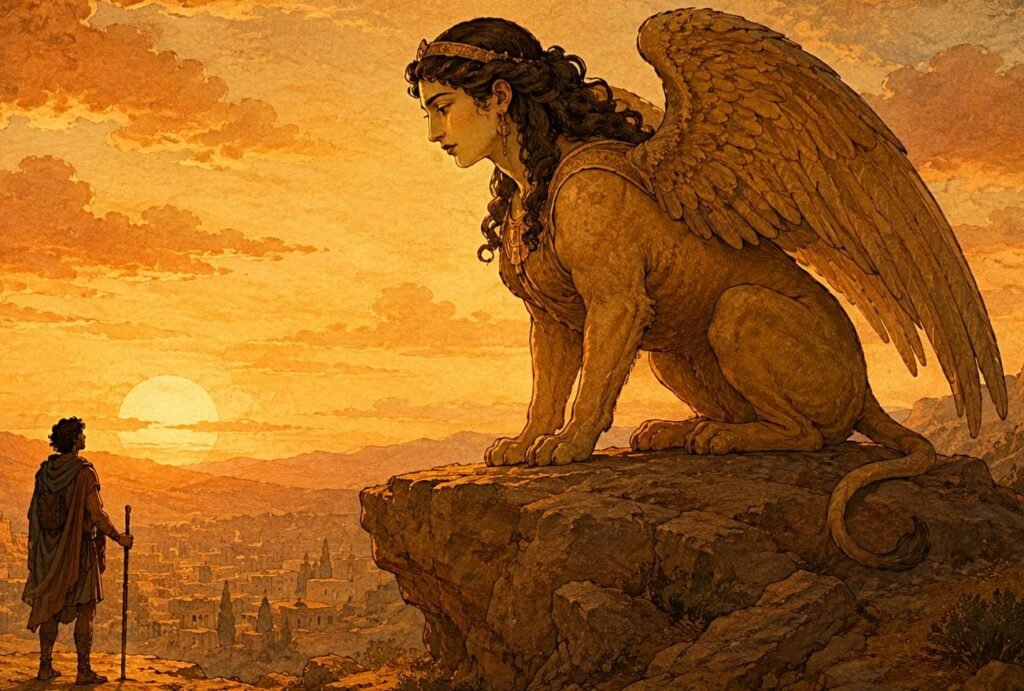
This riddle comes from the Greek tragedy Oedipus Rex by Sophocles, first performed around 429 BC. The story goes that the city of Thebes was being terrorized by the Sphinx, a creature with the head of a woman, the body of a lion, and the wings of a bird. She sat on a rock outside the city gates and asked every traveler the same question. Those who could not answer were killed. The Thebans were helpless until a stranger named Oedipus arrived. He heard the riddle and replied, “Man.” The Sphinx, defeated, threw herself from her rock to her death. The monster had guarded the gate, but the riddle was the real weapon.
Depictions of the Sphinx posing her riddle go back even earlier than Sophocles. Greek vase painters of the 6th century BC show her crouched on a pillar or rock, facing a traveler with a look that is part question, part threat. The riddle was already famous. Sophocles gave it its permanent home in literature, but the oral tradition that carried it was already centuries old by the time his play was written.
Riddles That Decide Life and Death
Riddle contests where the loser dies are not unique to Greece. In Norse mythology, the poem Vafþrúðnismál tells of Odin visiting the giant Vafþrúðnir in disguise, challenging him to a battle of wisdom. The stakes are the same: the one who cannot answer forfeits his head. In the Indian epic Mahabharata, the hero Yudhishthira is asked a series of riddles by a spirit guarding a lake. His brothers have already died drinking from the water without answering. Yudhishthira pauses, answers each question correctly, and brings them back to life. Across cultures separated by thousands of miles, the same pattern appears: knowledge is the price of passage, and the wrong answer is fatal.
The Egyptian Sphinx, by contrast, is a silent guardian. The Great Sphinx of Giza, carved around 2500 BC, predates the Greek myth by two millennia and asks no riddles at all. It faces east and waits. The Greeks encountered Egyptian sphinxes through trade and reinterpreted them. They gave their version a voice and a question, turning a stone sentinel into an intellectual predator. In the Greek mind, the most terrifying monster was the one that attacked not with claws but with language.
The Answer Hiding in Plain Sight
What makes this riddle still work three thousand years later is not wordplay but a trick of perception. Most riddles rely on double meanings or puns. This one relies on something harder: the listener forgetting what they are. Morning, noon, and evening make you think of a single day. You start searching for an animal with a strange life cycle, something that changes the number of its legs as the hours pass. You do not think to look down at yourself. The riddle exploits the gap between observing the world and observing your own existence.
There is a grim irony built into the story. Oedipus solves the riddle of human life perfectly. “Man” is the one creature that crawls, then walks, then leans on a staff. He understands what every person is. And yet the tragedy of the play is that he does not understand who he himself is. He does not know his own parents, his own crimes, his own fate. He can read the universal human condition but is blind to his own. The riddle is a mirror held up by a monster, and even the man who gives the right answer fails to see his reflection.
Try Another Riddle?
Round as an Apple, Deep as a Cup — Daily Riddle
I Have Cities but No Houses — Daily Riddle
Forward I Am Heavy, Backward I Am Not — Daily Riddle