An Anglo-Saxon poet once noticed something funny and a little sad happening in a monastery library. A tiny creature was devouring some of the most brilliant words ever written, page by page, night after night. And it had absolutely no idea what it was eating.
A moth ate words. That seemed to me a curious happening, when I heard about that wonder, that the worm, a thief in the darkness, swallowed a certain man’s song, a glory-fast speech and its strong foundation. The stealing guest was not at all the wiser for that, for those words which he swallowed.
Here’s a hint: this little thief lives in a place full of knowledge, feasts on it every night, and learns absolutely nothing.
Click to Reveal the Answer
A Bookworm 🐛
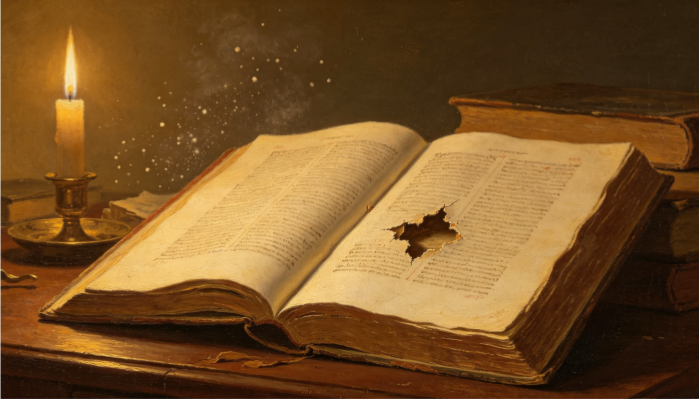
A moth larva chewing through the pages of a handwritten manuscript. It eats the words, the parchment, the binding, everything. But it understands none of it. The greatest feast of knowledge in the world, completely wasted on the guest.
The Thief Who Ate a Library
This is Riddle 47 from the Exeter Book, the great 10th-century manuscript of Old English poetry. In just seven lines of alliterative verse, the poet describes a moth larva tunneling through a handwritten manuscript in the dark, devouring the ink, the parchment, and the leather binding of what was once someone’s life’s work. The Old English opening line is wonderfully blunt: Moððe word fræt (“A moth ate words”). But then the poet slows down to marvel at what just happened. A “thief in the darkness” has swallowed a man’s gied (song), his þrymfæstne cwide (glory-fast speech), and its strangan staþol (strong foundation). And after all that, the thief is “not one whit the wiser.” It ate a masterpiece and gained nothing.
The riddle didn’t come from nowhere. It’s an Old English reworking of Enigma 16 by Symphosius, the Roman poet whose party riddles we’ve seen before in this series. Symphosius’s Latin version is just as sharp: “Letters fed me, but I do not know what letters are. I lived in books, but am no more studious for that. I devoured the Muses, but still have not myself progressed.” The Anglo-Saxon poet took those three neat lines and transformed them into something darker and more emotional, adding the image of a thief working in the dark, the sense of a specific person’s words being lost, and that devastating final judgment: not one whit the wiser.
What makes this riddle quietly brilliant is that it works on more than one level. On the surface, it’s about an insect eating a book. But medieval monks would have recognized a deeper joke. The Latin word ruminatio meant both “chewing” and “meditating deeply on a text,” and a good monk was supposed to ruminate on scripture the way a cow chews its food: slowly, thoroughly, drawing out every last bit of nourishment. The bookworm is the perfect anti-reader. It chews every page but digests nothing. It’s a gentle warning dressed up as a riddle: don’t be the worm. Don’t consume words without understanding them.