

Do you remember the first time you watched a horror movie and had to sleep with the lights on? Classic horror films of the 1980s didn’t just scare people; they revolutionized the way horror movies were made, using unprecedented special effects to create unique atmospheres and captivating characters, even giving rise to some iconic villains that are still talked about today.
Many “best” lists often overlook the behind-the-scenes stories. Some of these films won the first Academy Awards for their respective genres. Others even used real human skeletons collected from pharmacies. Still others were box office flops but are now housed in renowned museums. Here are ten important horror films of the 1980s, ranked from tenth to first. Each film has a story that made it a legend.
The 10 Best 80s Horror Movies
#10 — Hellraiser (1987)
a candlelit London attic, a brass puzzle box turning in Frank Cotton’s hands, then the chains and the hooks and the wet collapse of a body — and from the shadows, a tall pale figure with pins driven into a perfect grid across his skull, surveying the wreckage with the calm of a parish priest at a baptism. Hellraiser opened in September 1987, designed, drawn, and directed by Clive Barker himself.
Clive Barker, a 34-year-old British novelist known for the Books of Blood, had already seen two of his screenplays mishandled by other directors and wanted to direct his own work. He asked producer Christopher Figg for the smallest budget that would let a first-timer try. New World Pictures put up $900,000. Barker adapted his 1986 novella The Hellbound Heart and cast his friend Doug Bradley as the lead Cenobite — a role the script called “Hell Priest” and the crew nicknamed “Pinhead.”
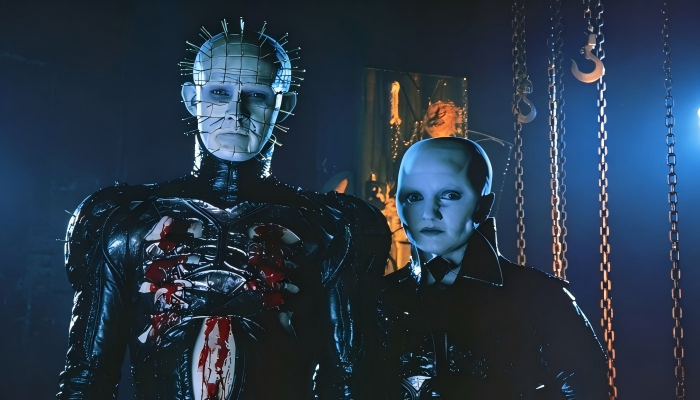
The film grossed about $20 million and launched nine sequels. Two early decisions shaped its identity. After a Toronto screening, Stephen King told reporters, “I have seen the future of horror, and his name is Clive Barker,” giving Barker immediate credibility in the American market. And Barker replaced the industrial demos by the band Coil with Christopher Young’s orchestral score, which gave the film a solemn, almost religious tone rather than a purely transgressive one.
#9 — Beetlejuice (1988)
Adam and Barbara Maitland die in the opening minutes of Tim Burton’s second feature—their car plunges from a covered bridge into the river below—and spend the rest of the film trying to haunt the New York couple who have bought their Connecticut farmhouse. The premise turns the haunted-house story inside out. The ghosts are the protagonists. The living are the intruders.
Warner Bros. spent months pushing to rename the film House Ghosts, uneasy with a horror-comedy whose ostensible star, Michael Keaton’s Betelgeuse, appears in only seventeen of its ninety-two minutes and improvises much of his dialogue under heavy prosthetics.
The dramatic weight sits elsewhere—with Alec Baldwin and Geena Davis as the Maitlands, with Catherine O’Hara as the social-climbing stepmother Delia, and above all with Winona Ryder, then sixteen, as Delia’s stepdaughter Lydia, the only living character who can see the ghosts. Burton, twenty-nine and with one feature behind him, was given fifteen million dollars and returned a film that grossed roughly seventy-five million and won the Academy Award for Best Makeup.
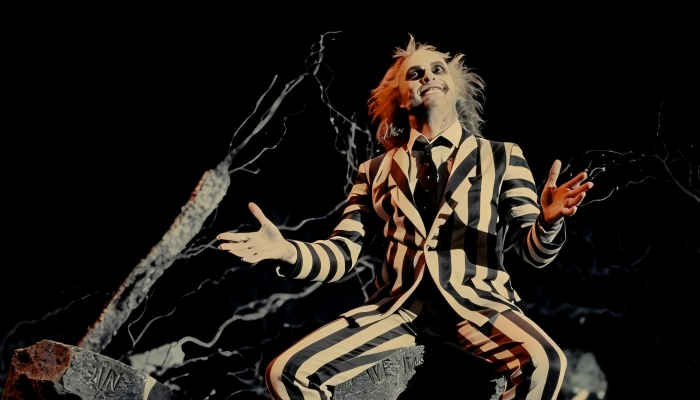
The most enduring sequence confirms where the film’s center of gravity actually lies, and Betelgeuse is nowhere in it. At a dinner party meant to impress Delia’s art-world friends, an unseen force possesses the guests, marches them through a choreographed rendition of Harry Belafonte’s “Day-O,” and animates the shrimp cocktails to claw at their faces. Burton was convinced it wouldn’t play. It became the image the film is remembered by—evidence that the marquee character was always the diversion, and the haunting itself the show.
#8 — An American Werewolf in London (1981)
David Kessler (David Naughton), a 22-year-old American backpacker, is attacked by something on the Yorkshire moors, wakes up in a London hospital, and six weeks later stands naked in a bare apartment as his hand elongates, his spine cracks forward, and his face pushes into a snout. Earlier werewolf cinema had relied on dissolves and jump cuts to manage the change. John Landis kept Rick Baker’s bladder rigs and prosthetic appliances on camera under unflattering clinical light, in real time, with no cutaways. Nothing in the staging cues the audience to read the body horror as a joke.
Landis had been told, repeatedly, that this was the film’s problem. He wrote the first draft in 1969 and spent twelve years hearing from financiers that the script was too scary to be a comedy and too funny to be horror. PolyGram Pictures eventually gave him $5.8 million; Universal pushed for Dan Aykroyd and John Belushi as the leads, but Landis cast Naughton and Griffin Dunne, both near-unknowns. The casting was a defensive choice. Aykroyd and Belushi—coming directly off The Blues Brothers, which Landis had just made with them—would have pulled the film into the comedy register he was specifically trying not to default to.
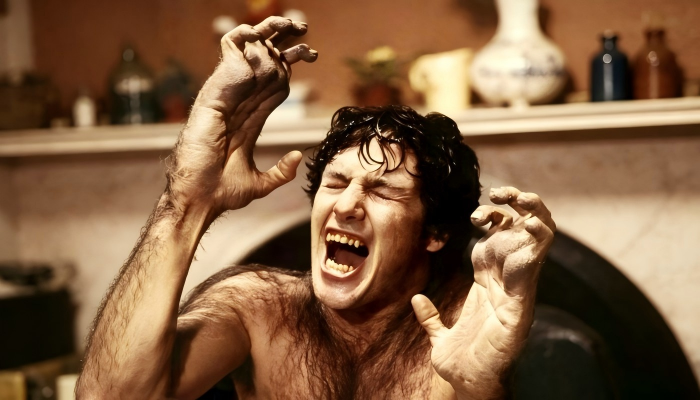
The comic register lives instead with Dunne. Jack, the friend on the moor, is killed in the opening sequence and then keeps reappearing throughout the film as a progressively decomposing corpse, turning up in hospital rooms and porn theaters to nag David about killing himself before the next full moon.
Dunne plays the lines flat, as deadpan as a sitcom guest at a brunch—the comedy is in how unbothered the corpse is by being a corpse. Neither register interferes with the other. The transformation stays terrifying because nothing in the comedy reaches in to soften it; Jack stays funny because nothing in the horror reaches in to weigh him down. At the 54th Academy Awards, Baker collected the first competitive Oscar for Best Makeup, a category the Academy had created largely in response to his work on this film.
#7 — Gremlins (1984)
In a Kingston Falls kitchen on Christmas Eve, Lynn Peltzer (Frances Lee McCain) shoves a hissing green-skinned gremlin into a running microwave and watches it explode against the glass door. That single shot is why American movies today come rated PG-13. Joe Dante’s Christmas creature-feature opened June 8, 1984, with a PG rating. Parents who brought their children expecting another E.T. sat through a gremlin getting blended, another stabbing a teacher with a hypodermic needle, and a monologue about a father dying dressed as Santa in a chimney.
Dante, a 37-year-old Roger Corman alumnus, made the film for $11 million under Steven Spielberg’s Amblin Entertainment banner. It grossed $148 million domestically, fourth-highest of 1984, behind Beverly Hills Cop, Ghostbusters, and Indiana Jones and the Temple of Doom. Hoyt Axton plays Rand Peltzer, the struggling inventor who buys the Mogwai at a Chinatown antique shop; Zach Galligan plays his son, Billy; Phoebe Cates plays the love interest Kate, who delivers the film’s infamous Christmas Eve monologue.
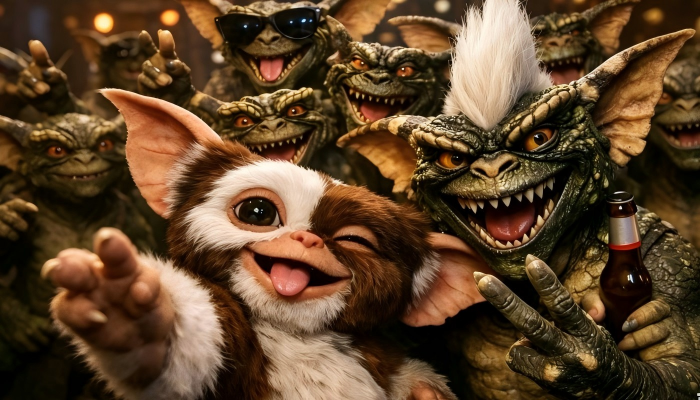
The complaints started the week of release. Spielberg called MPAA chief Jack Valenti, proposed a new rating category between PG and R. Six weeks later, on July 1, 1984, PG-13 was announced.
Red Dawn became the first film released under the new rating in August. Every modern tentpole owes this movie — and Temple of Doom, released five weeks earlier with its heart-extraction scene — a structural debt. Dante later filmed Gremlins 2: The New Batch (1990) as a direct parody of everything that had changed about studio filmmaking in the six years since his first one, including the self-aware moment when a gremlin holds up a copy of the Gremlins contract. The joke only lands because Gremlins itself rewrote the rules it was mocking.
#6 — Poltergeist (1982)
Diane Freeling (JoBeth Williams) slides into a muddy unfinished swimming pool behind her suburban tract home during a rainstorm, and human skeletons begin surfacing around her—arms, ribs, skulls breaking through the sludge while she thrashes and screams. The bones were real. The production had bought thirteen medical-grade skeletons from a biological supply house because, in 1982, it was cheaper than sculpting them in latex, and Williams wasn’t told until after the sequence wrapped.
The detail is characteristic of the film’s whole production. Tobe Hooper, the 39-year-old director of The Texas Chain Saw Massacre, was hired because Steven Spielberg, who conceived and co-wrote Poltergeist, was contractually barred from directing two films at once and had committed to E.T. Spielberg was reportedly on set most days, designing storyboards and overseeing shots; cast members spent decades afterward arguing about who had actually directed them. The resulting film is recognizably neither filmmaker’s alone. It has none of Chain Saw’s grain or cruelty, but its horror is sharper and more anatomical than anything in Spielberg’s own work before or since.
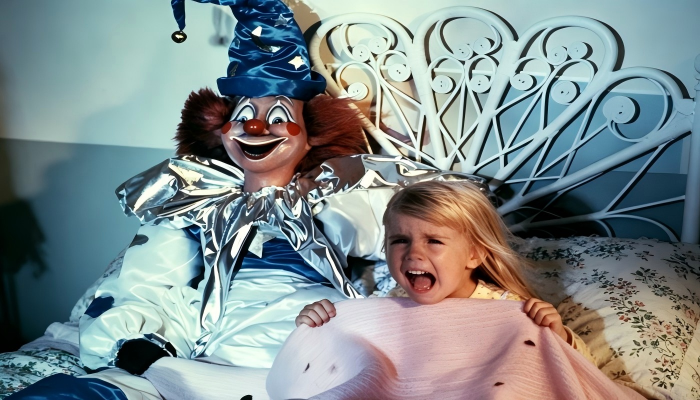
What the two registers are working on is the most Spielbergian setting imaginable. The Freelings live in a Cuesta Verde tract home with a two-car garage, three children, and a swimming pool under construction in the backyard. The horror enters through the most ordinary objects in the house—the television, the bedroom closet, a steak left on the kitchen counter, eventually the pool itself. E.T. opened a week before Poltergeist in June 1982 with the same starting ingredients: the same kind of suburb, the same kind of family, an otherworldly presence at the center of a child’s life. E.T. used those ingredients to find wonder under the suburb. Poltergeist used them to find what was buried under it.
#5 — Aliens (1986)
Ripley (Sigourney Weaver) climbs into a power-loader exosuit in a dropship cargo bay and goes hand-to-hand with the Alien Queen—a fourteen-operator puppet designed by Stan Winston—to recover a nine-year-old girl. The line she delivers as the hydraulics engage (“Get away from her, you bitch”) closes a performance that runs essentially uninterrupted through all 137 minutes of the film. Weaver is the picture’s structural anchor.
Nothing else about Aliens reads as prestige. James Cameron, 31, fresh off The Terminator, was hired to convert Ridley Scott’s 1979 haunted-house horror film into a war movie. He pitched the sequel by writing the original title on a whiteboard and adding an “S.” The $18 million production grossed $131 million worldwide and won Oscars for Visual Effects and Sound Effects Editing—the categories genre cinema had always been allowed to win.
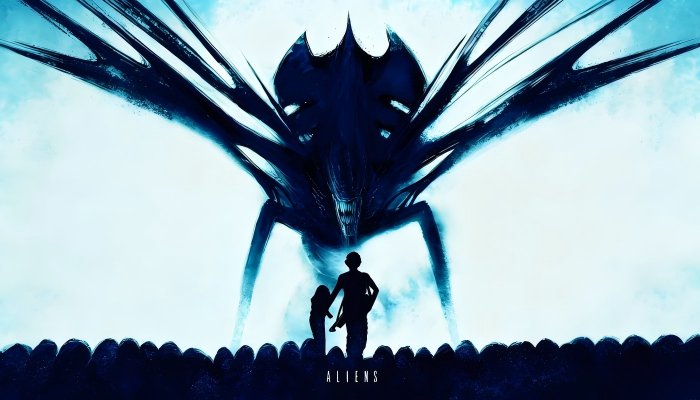
But the film also picked up a Best Actress nomination. At the 1987 Academy Awards, Weaver became the first lead actress nominee for a performance in a science fiction or action film. She was playing a traumatized survivor in a creature-feature sequel, and the Academy had decided the work itself counted, regardless of what kind of film it appeared in. Weaver lost to Marlee Matlin for Children of a Lesser God. Five years later, Jodie Foster won the same category for The Silence of the Lambs—a horror-thriller the Academy might earlier have categorized as ineligible.
#4 — The Fly (1986)
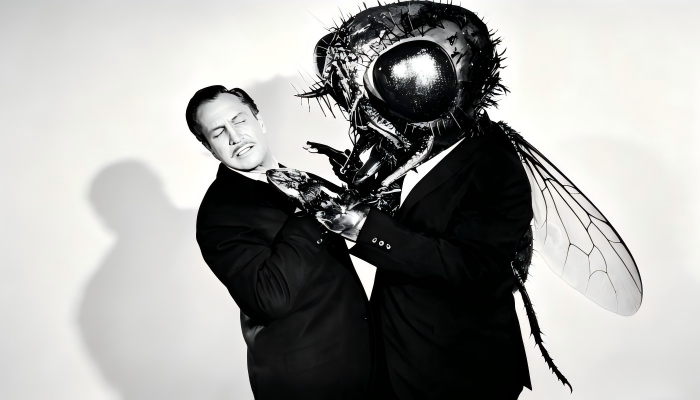
Seth Brundle’s fingernail drops off into the coffee saucer during breakfast. Veronica watches it happen across the table, says nothing. He picks it up, examines it, drops it in an ashtray, and keeps eating. The horror of David Cronenberg’s The Fly is that it isn’t a monster movie. It’s a terminal-illness chamber drama with two people at a kitchen table, one of them slowly ceasing to be human.
Jeff Goldblum, then 33, plays Seth Brundle, the eccentric inventor who builds a teleportation pod and fails to notice a housefly in the chamber during his first human test. Geena Davis plays Veronica Quaife, the science journalist who has begun to fall in love with him. Goldblum and Davis were a couple in real life while filming, and it shows. The early lab scenes between them don’t feel acted—they feel like two people who already know each other being filmed in a room.
That intimacy is what makes the second half work. By the time Brundle’s body starts to fall apart, we aren’t watching him turn into a monster; we’re watching Veronica lose someone she loves.
John Getz plays her ex and editor Stathis Borans, the third person in the room and the only one of the three still alive at the end.
At the 59th Academy Awards in March 1987, Chris Walas and Stephan Dupuis won Best Makeup. That statuette remains the only Oscar any Cronenberg-directed film has ever won. Goldblum, widely tipped for a Best Actor nomination for the same performance, was not nominated. The split is the film in microcosm: the Academy could see what was happening to Brundle’s face, but couldn’t see what was happening behind it.
#3 — A Nightmare on Elm Street (1984)
Tina Gray (Amanda Wyss) is dragged up the wall of her bedroom and across the ceiling by something only she can see, screaming and bleeding while her boyfriend wakes beside her on the bed and watches her body twist against gravity. The bedroom wasn’t a set; it was a rotating room. The bed, the lamp, the dresser, and Wyss were all bolted to its surfaces, and the entire chamber turned 360 degrees on a horizontal axis while a stationary camera filmed from outside. The bed appears to be still. The room is moving around it.
That image holds the film’s whole idea. Wes Craven, then 45, had built the script around a Los Angeles Times series in the early 1980s about Southeast Asian refugees in California who had died in their sleep after telling family members they were afraid to go to bed because of the dreams. In the slashers that immediately preceded A Nightmare on Elm Street, the heroine survived by running. Craven’s premise gave Nancy Thompson (Heather Langenkamp) no space to run.
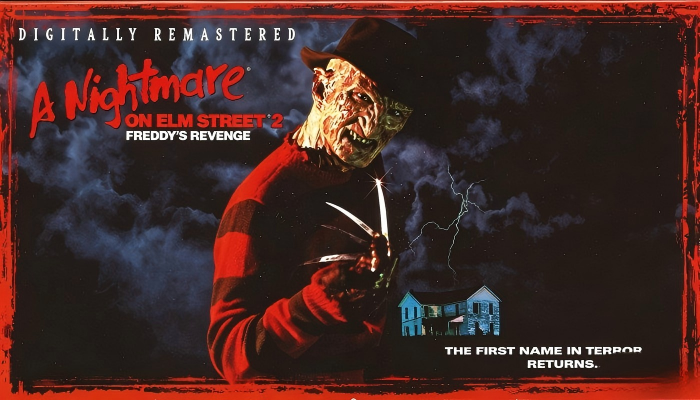
The threat wasn’t somewhere she could flee to or from; it was waiting on the other side of consciousness. Freddy Krueger (Robert Englund) is the only major slasher villain of the period who doesn’t pursue his victims at all. He waits for them to lie down.
The film cost $1.8 million and grossed $57 million worldwide, saving its distributor, New Line Cinema, from impending bankruptcy and earning the company its long-running nickname, “The House That Freddy Built.” But the formal innovation outlived the franchise machinery. Nancy survives by trying to stay awake—doing what no slasher heroine had been asked to do before. She isn’t running faster than the killer; she’s resisting a biological function. The terror Craven landed on isn’t being hunted. It’s not being able to rest.
#2 — The Thing (1982)
A sled dog runs across the Antarctic ice, chased by a Norwegian helicopter whose crew is trying to shoot it. The American research station takes the dog in. Later that night, the dog walks into the kennel, and Rob Bottin’s practical effects take over—a head splits vertically, tentacles emerge, jaws appear inside jaws, defibrillator paddles press against a chest that turns into a mouth and bites the doctor’s arms off at the elbows. The sequence took five weeks to shoot. Critics called it a geek show. Audiences stayed home.
John Carpenter, 34, had made Halloween, The Fog, and Escape from New York on independent budgets. The Thing was his first studio assignment; Universal gave him $15 million. Kurt Russell’s R.J. MacReady leads an ensemble of unsympathetic men—Keith David, Wilford Brimley, Richard Dysart, Donald Moffat—isolated in the polar dark and unable to verify which of them is still human. The film opened June 25, 1982, two weeks after E.T., and audiences who had watched Spielberg’s friendly alien phone home were not in the market for an alien that digested huskies.
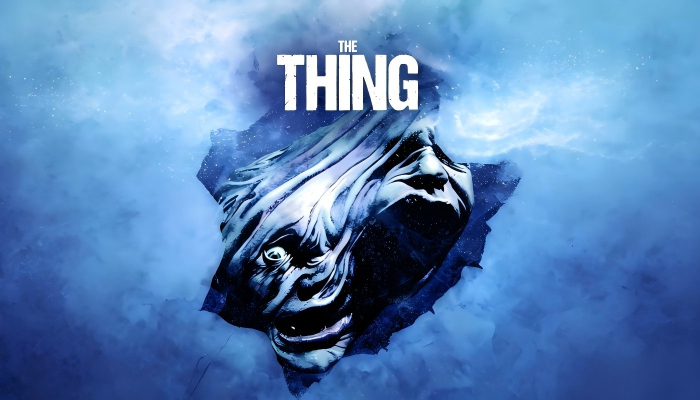
The domestic gross was $19.6 million. Carpenter later called it the failure he took hardest. The reviews fell into a pattern: too gory, too cold, too cynical; characters too thin to mourn; an ending too bleak to leave the theatre on.
Forty years on, the same qualities are what get praised. The bleakness reads as integrity, the ensemble’s coldness as restraint, Bottin’s body horror as the most uncompromising practical-effects work ever attempted on a studio film. Critics began the rehabilitation in the 1990s; fans completed it on home video; in early 2026 the Library of Congress inducted The Thing into the National Film Registry, citing an influence that runs from Reservoir Dogs to Stranger Things. The original reception got every observation right. It got the verdicts backwards.
#1 — The Shining (1980)
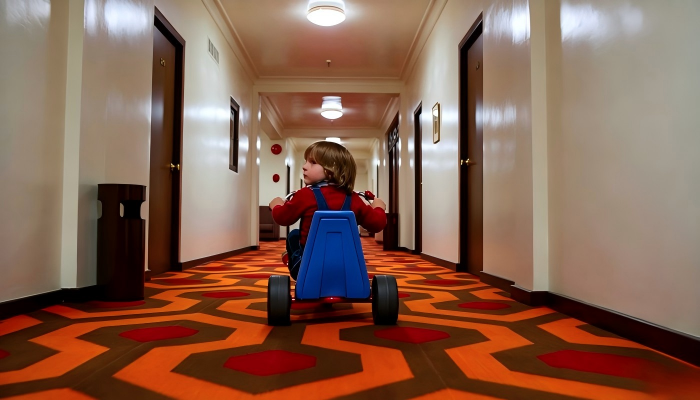
Danny Torrance, five years old, rides his Big Wheel along the carpeted corridors of the empty Overlook Hotel. The camera glides behind him at knee height on a Steadicam—the stabilized rig Garrett Brown had developed only five years earlier, and which Kubrick used here more aggressively than any director before him. The scene’s horror isn’t really the Grady twins waiting at the far end of the corridor. It’s the corridor itself: how long it is, how the carpet pattern repeats, how the camera advances at child-height through a space that should be welcoming and isn’t. Stephen King has spent forty-five years publicly disowning the adaptation. The film sits atop every serious horror ranking anyway.
Stanley Kubrick, then 51, had made 2001: A Space Odyssey, A Clockwork Orange, and Barry Lyndon. The Shining was his only horror feature. Jack Nicholson plays Jack Torrance, a writer who takes a winter caretaker job at an isolated Colorado hotel and brings his wife Wendy (Shelley Duvall) and son Danny (six-year-old Danny Lloyd, in his first screen role) with him. Kubrick’s perfectionism on the production has long been packaged as legend: 148 takes for a single Hallorann-and-Danny dialogue scene, 127 takes for the staircase sequence in which Duvall fends off Nicholson with a baseball bat. That second figure reads differently now—Duvall has said in the years since that the experience was abusive. Whatever else Kubrick was building, he was building it primarily through what an actor’s body did inside a hotel he had constructed full-scale at Elstree Studios.
King’s resistance has not softened. He has called the film a beautiful Cadillac with no engine, and his diagnosis is technically accurate—the engine of his novel was a recovering alcoholic and the people he was failing, and that engine has been deliberately removed. What’s left is the building. In 1997 King produced a faithful television miniseries—directed by Mick Garris, aired on ABC—as a corrective; almost no one watched it.
The Kubrick version, meanwhile, absorbed the surrounding culture instead of being absorbed by it. Room 237 (2012) is a feature-length documentary about people who can’t stop watching the film. Doctor Sleep (2019), Mike Flanagan’s adaptation of King’s own sequel novel, had to set its climax inside reconstructions of the Kubrick Overlook to be legible. The book was written and disowned, and rewritten. The film stayed exactly where it was.
Why the 1980s Became Horror’s Most Influential Decade
The 1980s became horror’s most influential decade through a convergence of forces. The genre inherited a foundation laid by 1970s landmarks like The Exorcist, The Texas Chain Saw Massacre, Halloween, and Alien, then found fertile soil in Reagan-era conservative anxieties, Cold War dread, AIDS panic, and the rise of teen culture.
At the same time, the VHS boom transformed distribution, bringing low-budget horror into living rooms and giving birth to a distinctive “video nasty” subculture.
This decade forged the genre grammar that still governs horror today. The slasher matured through Friday the 13th, A Nightmare on Elm Street, and Child’s Play, producing pop-culture icons like Freddy, Jason, and Chucky.
Practical effects masters—Tom Savini, Rob Bottin, Rick Baker—pushed body horror to peaks rarely matched since, as seen in The Thing, An American Werewolf in London, and The Fly.
Films like The Evil Dead and Gremlins fused horror with comedy, expanding the genre’s borders. Its echoes ripple through Scream‘s meta-narratives, the retro nostalgia of Stranger Things and It, and virtually every corner of contemporary horror aesthetics. That decade is still being looked back upon, again and again.