In 1979, a crew of seven woke up aboard a grimy space freighter, answered a distress call they shouldn’t have, and changed cinema forever. Ridley Scott’s Alien fused science fiction with pure horror in ways no film had managed before.
But the movie’s power didn’t come from a massive budget or cutting-edge technology. It came from ingenuity, obsession, and a string of happy accidents. Here are fifteen behind-the-scenes facts that prove the making of Alien was nearly as wild as the film itself.
How the Film Was Born
1. It was almost called Star Beast.
Dan O’Bannon’s original screenplay carried the working title Star Beast, a name he never liked. One night, rereading his own script, he noticed how often the word “alien” appeared and realized it had never been used as a film title before.
The word worked as both a noun and an adjective. Simple, strange, and impossible to forget. O’Bannon knew instantly he had his title, and it never changed again.
2. The script went through major transformations before it became a classic.
The Alien we know didn’t spring fully formed from anyone’s imagination. Producers David Giler and Walter Hill made significant revisions and additions to O’Bannon’s script, though they weren’t credited for their contributions. Names shifted, characters evolved, and the film’s tone was reshaped from a low-budget creature feature into something far more atmospheric. Classic films rarely start out feeling classic. They’re hammered into shape.
3. O’Bannon stole from everybody and admitted it.
O’Bannon wore his influences proudly. The Thing from Another World (1951) inspired the idea of professional men hunted by a deadly creature in a claustrophobic environment. Forbidden Planet (1956) contributed the concept of a ship warned not to land, then losing crew members one by one. Planet of the Vampires (1965) featured a scene in which explorers discover a giant alien skeleton — a direct precursor to the derelict spacecraft sequence.
He also drew from short stories by Clifford D. Simak and Philip José Farmer. As O’Bannon put it himself: he didn’t steal Alien from anybody — he stole it from everybody.
The Monster and the Visual Design
4. The studio thought H.R. Giger’s artwork was too horrifying to use.
Swiss surrealist H.R. Giger was ultimately responsible for the alien’s unforgettable look, but the studio initially resisted. Executives found his artwork too horrific for audiences, though the producers at Brandywine pushed hard for him to be hired. Ridley Scott flew to Zurich, met Giger in person, and brought him on to design everything related to the creature and its environment from the egg to the adult xenomorph. It was one of the most consequential hiring decisions in film history.
5. The eerie blue light over the eggs was borrowed from a rock band.
One of the film’s most haunting images, that thin membrane of blue light hovering above the alien eggs, came from an unlikely source. The Who were rehearsing for a concert at Shepperton Studios, testing laser equipment on a neighboring soundstage. Production designer Roger Christian saw the lasers, realized they could replace the biological membrane Scott had envisioned, and dragged the director over to have a look. Scott wanted the egg chamber to feel ancient, mysterious, and protected, and the borrowed laser, fanned through stage smoke, delivered exactly that.
6. Ridley Scott used his own children to fake the Nostromo’s scale.
A 58-foot landing leg was built for the ship’s exterior shots. Scott took one look and declared it wasn’t big enough. His solution was pure old-school filmmaking: he dressed his two sons and a cameraman’s child in miniature spacesuits, placed them on the landing elevator, and let forced perspective do the rest. On screen, the leg suddenly appeared to tower eighty feet high. No CGI required, just three kids and a clever camera angle.
7. The Nostromo’s corridors were built from bomber parts and mirrors.
The ship’s claustrophobic interior was one of Alien‘s most powerful storytelling tools. The Nostromo’s interior was constructed from old airplane parts and industrial pallets, with upturned milk crates for flooring. Mirrors extended the corridors visually, making them appear longer and more disorienting than they actually were. Scott insisted on fully enclosed sets, trapping both the characters and the audience in a space with no escape.
How Hard the Shoot Was
8. Over 200 crew members built the major sets by hand.
Nothing in Alien was quick or easy to construct. More than 200 crew members built the principal sets, including the planet surface, the derelict ship, and the Nostromo interiors, across an intense fourteen-week shoot at Shepperton and Pinewood Studios. Every surface, every rivet, every shadow was deliberate. The production operated on a tight schedule, with the studio pushing constantly to stay on time and on budget.
9. The spacesuits nearly suffocated the actors.
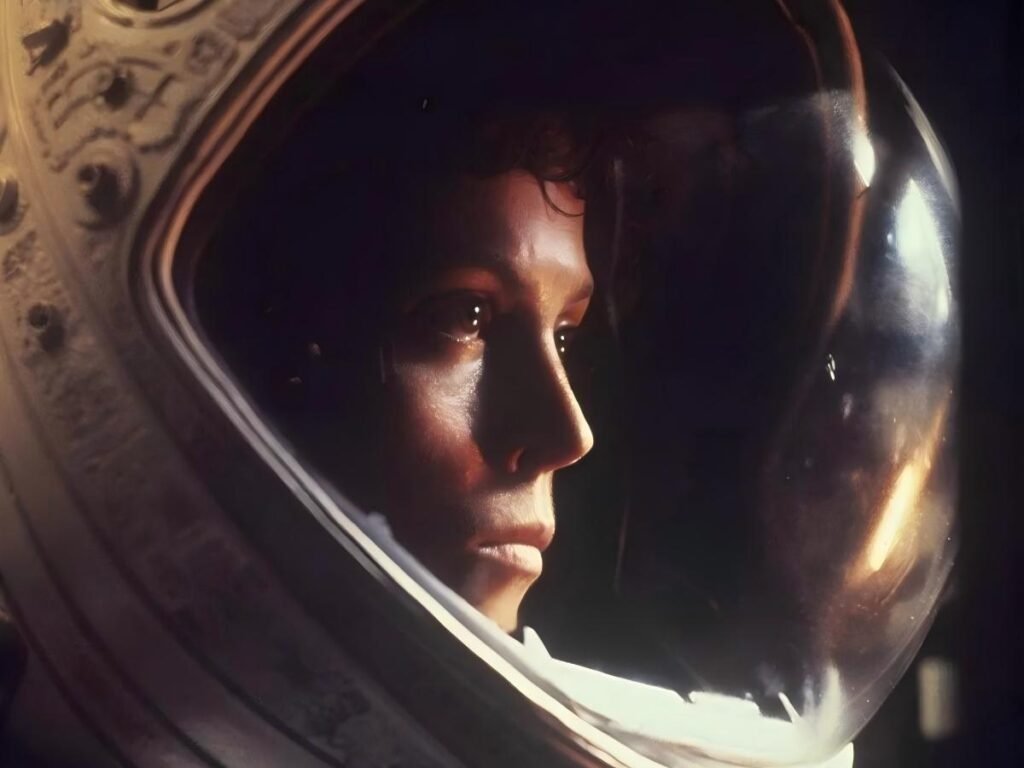
The EVA suits looked magnificent on camera. Wearing them was another story. The spacesuits were thick, heavy, and lined with nylon, making them difficult to breathe in. Combined with extreme heat on set, the conditions caused actors to nearly collapse. Oxygen systems had to be added, and nurses stood by with tanks between takes. The discomfort wasn’t wasted; it bled directly into the performances, giving the planet-exploration scenes an authenticity that pure acting might not have achieved.
10. Many of the most terrifying moments relied on practical trickery, not special effects.
In 1979, CGI wasn’t an option. Every scare in Alien was achieved with physical props, careful lighting, and — in at least one famous case- deliberate deception of the cast. For the chestburster scene, the cast was unaware that high-pressure pumps were set to spray fake blood in all directions. The reactions caught on camera were genuine. The terror you see on Veronica Cartwright’s face when the creature erupts from John Hurt’s chest? That’s not acting. That’s shocking.
The Most Iconic Scenes
11. The chestburster’s design traces back to a Francis Bacon painting.
Ridley Scott drew visual inspiration from fine art as much as from genre films. The chestburster design was inspired by Francis Bacon’s 1944 painting Three Studies for Figures at the Base of a Crucifixion, a triptych of distorted, screaming figures that radiate primal dread. Giger later explained that the mouth was the creature’s most critical feature: it had to look like something built for chewing its way out of a human body.
12. John Hurt’s torso was fake — and there was a puppeteer under the table.
The mechanics behind the chestburster scene were brilliantly low-tech. Hurt was positioned beneath the dining table with only his head and arms visible, while a prosthetic torso packed with fake blood sat on the surface above him. A puppeteer crouched underneath, operating the creature on a stick. When the moment came, the combination of practical gore, a thrashing puppet, and the cast’s unscripted terror produced what remains one of the most visceral scenes in movie history.
13. The facehugger was made from sheep intestines.
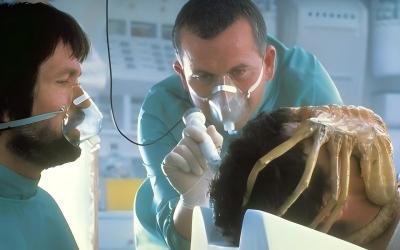
Organic materials gave the alien’s early life stages their revolting realism. The facehugger and its innards were crafted from sheep intestines, while Scott used pieces of fish and shellfish to create the dead facehugger’s viscera during the examination scene. High-pressure air hoses launched the creatures from their eggs at speed. The result looked and reportedly smelled like something genuinely alive.
After the Credits Rolled
14. The film received wildly different ratings around the world.
Audiences in different countries experienced Alien through very different regulatory lenses. In the United States, the film received an R rating. In the United Kingdom, it was classified X, the most restrictive category available at the time. Australia rated it M. Same film, same nightmare fuel, three entirely different assessments of who should be allowed to watch it.
15. Ripley redefined who could lead an action film.
When audiences first saw Alien, many assumed Tom Skerritt’s Dallas was the hero. His early death upended that expectation, and Sigourney Weaver’s Ripley emerged as the film’s true center of gravity, resourceful, terrified, and utterly determined. The producers specifically wanted a woman as the lead character, and Weaver, then largely unknown in film, impressed them so thoroughly in her audition that she won the role. Ripley proved that a female protagonist could anchor a science-fiction blockbuster, and her influence echoes through decades of genre filmmaking that followed.
Alien endures not because it’s scary, but because every element of its construction was executed with obsessive care. The art direction, the pacing, the creature design, the oppressive atmosphere: each was pushed to its limit by a team that refused to settle for “good enough.” That’s why, nearly half a century later, people are still talking about a movie where a monster hatches from a man’s chest at dinner. Some nightmares are built to last.