
Dogs have walked beside humans for at least 15,000 years. They’ve fought in our wars, ridden our subway systems, and even orbited the Earth before we did.
Despite the long history of dogs and humans, do you really fully understand this most human-friendly species? Here are 25 fun facts about dogs that prove your four-legged companion is far stranger and far more brilliant than you ever suspected.
Their Senses Operate on a Different Level
1. Dogs can smell time.
Your dog’s nose contains up to 300 million olfactory receptors. But the truly wild part isn’t range, it’s what they do with it.
Alexandra Horowitz, who runs the Dog Cognition Lab at Barnard College, argues that dogs track the passage of time through scent. When you leave for work, your smell lingers in the house and fades at a predictable rate.
Your dog learns that when your scent weakens to a specific level, that’s when the front door usually opens.
An NPR investigation in 2022 explored a hound mix named Donut who anticipated the school bus’s arrival every single day — likely by “reading” the decay of her owner’s scent molecules.
For dogs, space and time are woven together through smell, which, as one researcher pointed out, is oddly reminiscent of how physicists think about spacetime.
2. No two nose prints are alike.
Just like human fingerprints, every dog’s nose has a unique pattern of ridges and creases. The detail is so reliable that some organizations maintain nose-print databases for identification purposes.
Next time your dog presses a cold, wet snout against your hand, know that it’s leaving a signature no other dog on the planet could replicate.
3. They poop along Earth’s magnetic field lines.
A 2013 study published in Frontiers in Zoology tracked 70 dogs across 37 breeds for two full years, recording 1,893 defecations and 5,582 urinations.
Researchers from the Czech University of Life Sciences and Germany’s University of Duisburg-Essen discovered that when Earth’s magnetic field was calm, dogs consistently aligned their bodies along the north-south axis to do their business.
Even more striking: they actively avoided the east-west direction. Nobody knows exactly why. But that slow spin your dog does before squatting? It might be a compass calibration.
4. Dog ears are precision instruments.
Dogs have 18 muscles controlling each ear — humans have six. Those muscles let dogs rotate, tilt, and raise each ear independently, like a pair of furry satellite dishes.
So dogs can pinpoint the source of a sound in six-hundredths of a second. They also hear frequencies up to 65,000 Hz, well beyond the human ceiling of 20,000 Hz.
The Beatles reportedly placed a high-frequency tone at the end of “A Day in the Life” on Sgt. Pepper’s — audible to dogs, invisible to humans.
5. Their noses detect heat radiation.
Dogs can feel the world’s warmth through their noses. Research has shown that the naked, wet tip of a dog’s nose can sense faint thermal radiation, similar to how infrared sensors work.
This explains something that puzzled scientists for years: why blind and deaf dogs can still hunt successfully, because they’re reading heat signatures.
Cool Dog Facts About Intelligence and Emotion
6. The average dog knows 165 words. Some know over a thousand.
Psychologist Stanley Coren reviewed multiple studies and concluded that the average dog understands about 165 words and signals. The top 20 percent — what Coren calls “super dogs” can grasp more than 250.
But the real outlier was Chaser, a border collie trained by retired psychology professor John Pilley at Wofford College.
Chaser learned the names of 1,022 individual objects and could retrieve them on command. She could even learn new words through inference — if she knew every toy in a pile except one, and heard an unfamiliar word, she’d grab the unknown toy. That’s a reasoning skill most human toddlers can’t manage until age three.
7. Dogs read your face from left to right.
When dogs look at a human face, they scan from left to right — the same direction humans use to read facial expressions. Research has shown they can distinguish between happy and angry faces, even in photographs of strangers they’ve never met.
Interestingly, dogs only do this with human faces. They don’t scan other dogs’ faces this way. Thousands of years of co-evolution have wired them to decode us specifically.

8. Contagious yawning can reveal a dog’s empathy.
Dogs catch yawns from humans — but not from just anyone. Studies show that a dog is four times more likely to yawn in response to their owner than to a stranger. Researchers believe this selective contagion is linked to empathy.
In human infants, the absence of contagious yawning often correlates with lower empathy scores. Your dog’s sympathetic yawn might be a small, involuntary signal of emotional connection.
9. Dogs get jealous — and scientists proved it.
When the owners petted and talked to the fake dog, the real dogs pushed, snapped, and wedged themselves between their owner and the imposter. The jealousy wasn’t subtle. It was immediate and physical.
10. Their brains light up when they smell you.
Neuroscientist Gregory Berns at Emory University used fMRI scans to peer inside dogs’ brains. When dogs were presented with the scent of their owner, their caudate nucleus, which means the brain’s reward center, activated more strongly than it did for food, unfamiliar humans, or other dogs.
In other words, the neurological evidence says your dog’s love for you isn’t just behavioral conditioning. It’s a genuine reward response, baked into their brain chemistry.
Surprising Facts About Dogs’ Bodies
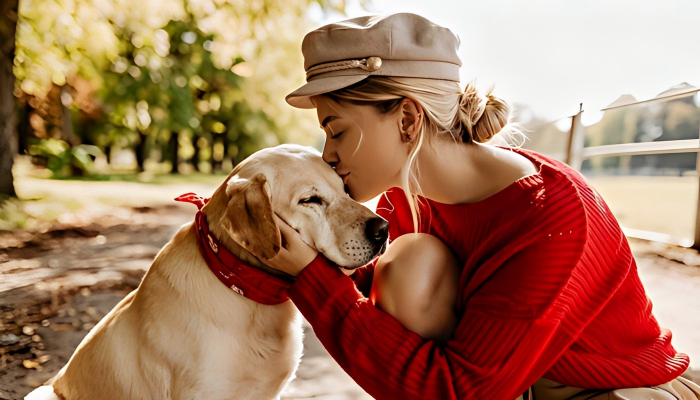
11. Their paws smell like corn chips
Dogs only sweat through the pads of their feet. That limited surface area means they rely mostly on panting to cool down.
But those sweaty paw pads, combined with naturally occurring bacteria picked up from the ground, create a distinctive odor that veterinarians affectionately call “Frito Feet.” You’re not imagining that corn-chip smell. It’s microbiology at work.
12. A Greyhound would beat a cheetah in a distance race.
Cheetahs can hit 70 mph — but only for about 30 seconds before they overheat. A Greyhound cruises at 35 mph and can sustain it for roughly seven miles. In a long race, the Greyhound overtakes the cheetah and keeps going. It’s like the tortoise-and-hare story.
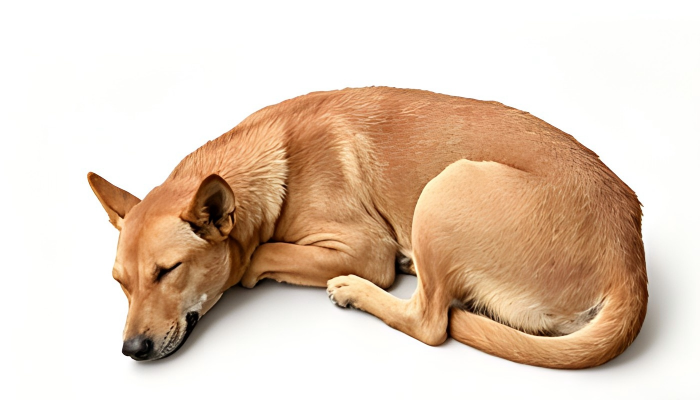
13. That sleeping curl protects their organs.
When your dog curls into a tight ball to sleep, it’s not just about warmth. The position is a holdover from wild ancestors who needed to shield their vital organs — heart, lungs, kidneys — from predators while in their most vulnerable state.
Thousands of years of domestic comfort haven’t overwritten the instinct.
14. Newborn puppies navigate by heat.
But nature gave them a workaround: specialized heat sensors in their noses that guide them toward their mother’s body warmth. They can’t see her or hear her, but they can feel exactly where she is.
15. Dogs have a secret third eyelid.
Beneath the visible lids sits a nictitating membrane — a translucent third eyelid that sweeps across the eye to protect it and distribute about one-third of the tear film.
Most of the time, you’ll never notice it. If you do see it prominently, that’s usually a sign that something’s wrong and worth a vet visit.
Amazing Dog Facts From History
16. A stray dog became the most decorated soldier of World War I.
In 1917, a stray of uncertain breed wandered onto the Yale University campus, where the 102nd Infantry Regiment was training. Private J. Robert Conroy adopted him, named him Stubby, and taught him to salute — which is exactly how the dog charmed the commanding officer into letting him stay. Conroy smuggled Stubby to France in his overcoat.
Over 18 months, Stubby fought in 17 battles. After surviving a mustard gas attack early on, he became hypersensitive to the faintest trace of gas — and would tear through the trenches barking soldiers awake during surprise attacks.
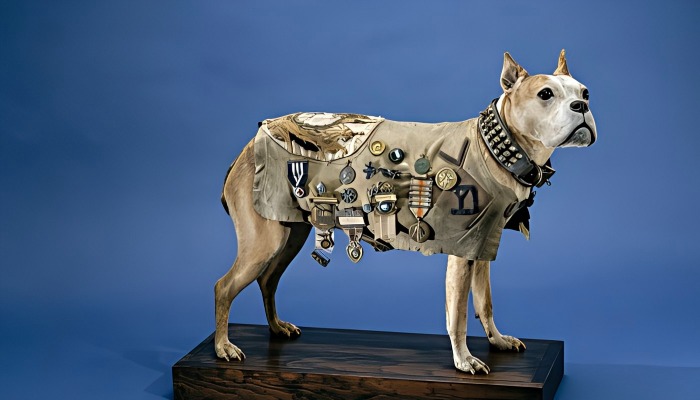
He located wounded men in no man’s land. And in the Argonne Forest, he caught a German spy mapping Allied trench positions by biting the man’s legs until American soldiers arrived.
That capture earned Stubby a promotion to Sergeant — the first dog in U.S. history to receive a rank through combat. He later met three presidents, got a half-page obituary in the New York Times, and today sits preserved in the Smithsonian.
17. A family pet captured an enemy machine-gun nest in WWII.
Chips was a German Shepherd-Husky-Collie mix donated by a New York family to the Dogs for Defense program after Pearl Harbor.
Serving in Patton’s Seventh Army, Chips charged a fortified machine-gun position (a pillbox) in Sicily — alone. He attacked the gunners, and four enemy soldiers surrendered.
The Army awarded him a Purple Heart, Silver Star, and Distinguished Service Cross, then revoked them all because military policy prohibited decorating animals.
18. A four-pound Yorkie became the first therapy dog on record.
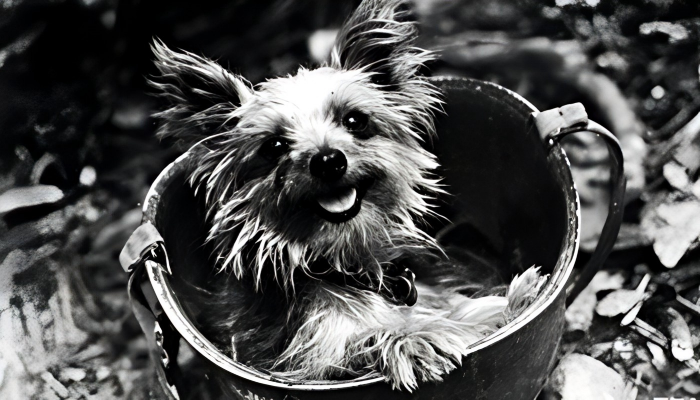
Smoky, a Yorkshire Terrier found in an abandoned foxhole in the Pacific, weighed barely four pounds.
She spent two years with the 5th Air Force, flying 12 combat missions and surviving 150 air raids and a typhoon. Her most famous feat: crawling through a 70-foot-long drainage pipe just eight inches wide to help engineers string telegraph wire — a job that would have otherwise required three days of digging under enemy fire.
Between missions, she visited wounded soldiers in hospitals, making her the earliest documented therapy dog in military history.
19. FDR’s dog changed the course of a presidential campaign.
Fala, Franklin Roosevelt’s Scottish Terrier, went everywhere with the president — the Oval Office, state visits, even a meeting with Churchill.
In 1944, Republicans accused FDR of accidentally leaving Fala behind in Alaska’s Aleutian Islands, then sending a Navy destroyer to retrieve him at a cost of millions in taxpayer money.
Roosevelt’s response, delivered at a Teamsters Union dinner on September 23, 1944, became one of the most famous campaign speeches in American history. He said his family could endure political attacks — but Fala could not.
Historian Doris Kearns Goodwin wrote that the laughter carried from the banquet hall into living rooms across America, and that even the most hardened Republican faces cracked a smile. The speech is widely credited with reviving Roosevelt’s fourth-term campaign.
When FDR died in April 1945, Fala crashed through a screen door and ran barking into the hills. He was buried beside Roosevelt in Hyde Park. A bronze statue of Fala sits at the FDR Memorial in Washington — the only presidential pet ever honored that way.
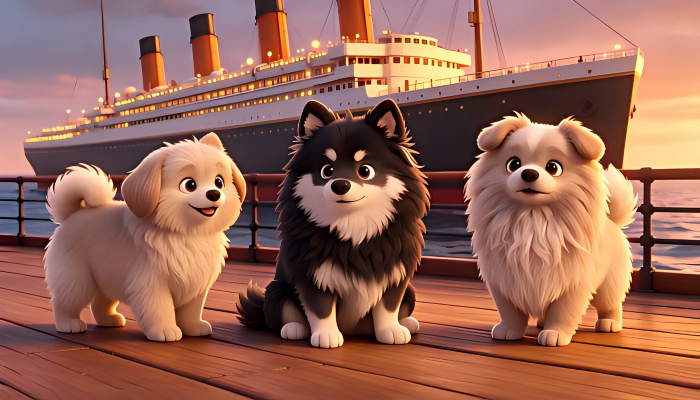
20. Three dogs survived the Titanic — all from First Class.
At least 12 dogs boarded the Titanic in April 1912. The ship had dedicated kennels on the boat deck, and a dog ticket cost as much as a child’s fare.
An informal dog show had been scheduled for April 15 — the morning after the iceberg. Only three dogs made it off the ship: Margaret Hays’ Pomeranian, wrapped in a blanket and mistaken for a baby in Lifeboat 7; Elizabeth Rothschild’s Pomeranian (she refused to board Lifeboat 6 without the dog); and Sun Yat Sen, a Pekingese carried by publishing heir Henry Sleeper Harper.
All three were small enough to conceal under a coat.
21. A Moscow stray orbited Earth before any human did.
She became the first living creature to orbit Earth. She had enough oxygen for about nine days, though she likely died much sooner from overheating.
Three years later, two dogs named Belka and Strelka completed an orbital flight and returned alive.
Soviet Premier Khrushchev gave one of Strelka’s puppies to President Kennedy as a diplomatic gift. Strelka’s descendants are still alive today.
Dog Trivia That’ll Surprise You
22. Dalmatian puppies are born completely white.
About 30 percent of Dalmatians are deaf in one ear and five percent in both — a consequence of the same extreme piebald gene responsible for their white coats.
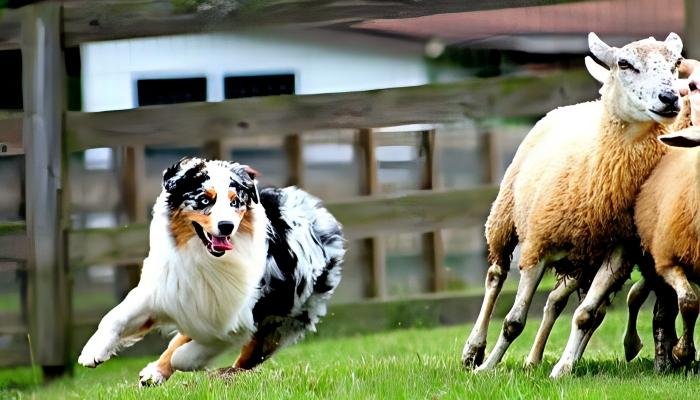
23. Australian Shepherds are actually American.
Australian Shepherds were developed in the western United States. They became popular among California ranchers and cowboys in the 19th century.
The “Australian” tag likely came from their association with Basque sheepherders who had spent time in Australia before emigrating to America.
24. One breed has six toes and can close its ears.
The Norwegian Lundehund was engineered by centuries of selective breeding for one specific job: hunting puffins on steep Norwegian cliffs.
Each foot has six fully formed toes for extra grip. Its ears fold shut to keep out debris while climbing. Its neck bends backward far enough to touch the spine.
As of 2022, only about 1,200 Lundehunds exist worldwide, most of them in Norway. It’s the only breed ever developed exclusively for puffin hunting.
25. One unspayed pair can produce 67,000 descendants in six years.
That statistic, widely cited by organizations like the MSPCA, is one of the strongest arguments for spay-and-neuter programs.
Humans spent thousands of years shaping dogs into the companions we know today — breeding them for loyalty, trainability, and emotional sensitivity.
But somewhere along the way, dogs shaped us right back. They changed how we live, how we wage war, and even how our brains release oxytocin.
The next time your dog stares at you from across the room, tail going, consider that you’re looking at 15,000 years of mutual evolution staring back.