A monk in 7th-century England looked up at the sky and wrote this riddle. The “sisters” he described have been around since the beginning of time, and you’ve seen them yourself a thousand times without thinking twice.
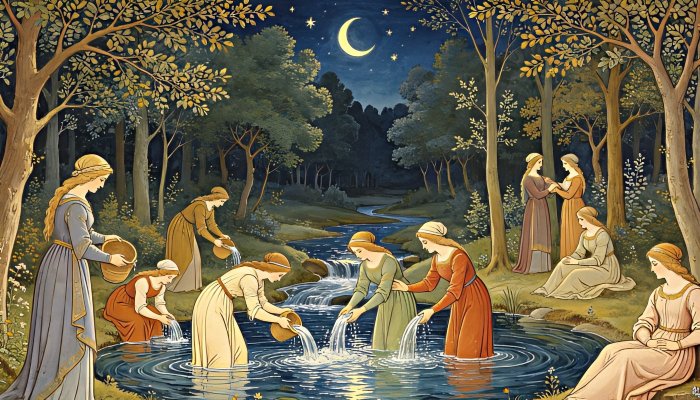
We are many sisters born together. Every night we are seen, every dawn we die. We are known to all, yet no man has visited us.
Here’s a hint: they only come out when the lights go off.
Click to Reveal the Answer
The Stars ✨
They appear together every night, vanish at every sunrise, and though every human being on earth has seen them, no one has ever reached them.
A Monk’s Map of the Universe
This riddle is number 6 in the Enigmata of Aldhelm (c. 639-709), a scholar, abbot, and bishop who became the first major English poet to write in Latin. Aldhelm composed his hundred riddles as part of a treatise on poetry and metre, and sent them to King Aldfrith of Northumbria. But the riddles quickly took on a life of their own, becoming one of the most widely copied and taught texts in early medieval Europe.
The first eight riddles form a deliberate sequence that maps out the created universe from the ground up: Earth, Wind, Cloud, Nature, Moon, Stars. By placing the stars at number 6, Aldhelm was building a kind of poetic cosmology, a guided tour through God’s creation written as a series of puzzles.
For a monk-scholar steeped in the writings of Isidore of Seville and the Church Fathers, describing the natural world wasn’t just an intellectual exercise. It was an act of devotion, a way of showing that even the most ordinary things, a gust of wind, a puddle of ice, a sky full of stars, were worth contemplating.
What gives this particular riddle its charm is the word “sisters.” Aldhelm could have called them lights or jewels or fires, all common metaphors. Instead, he made them family, born together, living together, disappearing together every morning.