
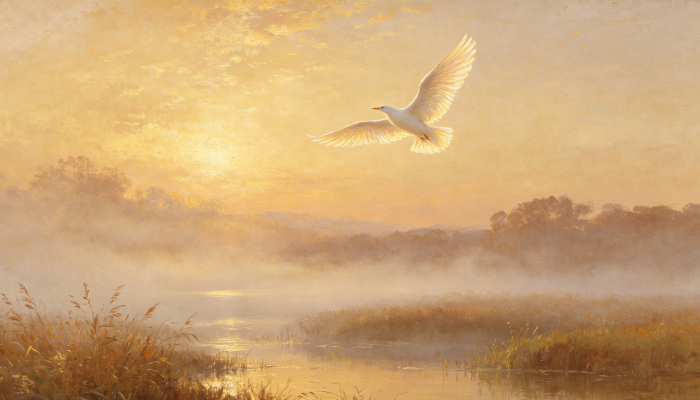
This might be the most beautiful riddle in the entire Exeter Book. Something moves through the world in three different ways: walking, swimming, flying. In two of them, it makes no sound at all. In the third, it becomes music.
My garment is silent when I tread upon the earth, or reside in my dwelling, or stir up the waters. Sometimes my apparel and this high air lift me over the dwellings of men, and the strength of the clouds carries me far over the people. My ornaments resound loudly and make music, sing clearly, when I am not resting on water and ground, a travelling spirit.
Here’s a hint: it’s a creature you might see gliding across a quiet lake in perfect silence. But watch what happens when it takes to the sky.
Click to Reveal the Answer
A Swan 🦢
On land and water, a swan moves in near silence. But in flight, its wings beat with a powerful, rhythmic whistling that can be heard from far away. Silent below, singing above.
The Bird That Sings with Its Wings
This is Riddle 7 from the Exeter Book, and scholars consider it one of the most securely solved riddles in the entire collection. It sits within a sequence of bird-riddles in the manuscript, but it stands out for its sheer beauty. The riddle describes a creature that exists in three states: walking on land, floating on water, and flying through the sky. In the first two, its “garment” (feathers) is completely silent. In the third, it “sings.” The trick is that the swan doesn’t sing with its voice. Its wings do the singing, beating the air with a deep, rhythmic whistling that anyone who has stood beneath a flying swan will never forget.
The bird in question is almost certainly the mute swan (Cygnus olor), which was common across medieval England and remains one of Britain’s most iconic birds. Its name is slightly misleading: the mute swan is quieter than other swan species when it comes to calling, but its wings produce a distinctive throbbing hum in flight that can carry across a lake. The Anglo-Saxon poet heard this sound and did something extraordinary with it. Instead of simply describing a bird, he turned it into a riddle about the relationship between silence and music. The “garment” is the swan’s plumage, and the “ornaments” that jangle and sing are its flight feathers cutting through the air. The same feathers, the same body, the same bird. Silent on the ground, singing in the sky.
The riddle’s final two words are what lift it from clever to genuinely moving: ferende gæst, “a travelling spirit.” In Old English, gæst can mean both “guest” and “spirit,” and the ambiguity is surely intentional. The swan in flight becomes something between a living creature and a ghost: a white shape drifting high overhead, singing a song that seems to come from nowhere, passing over the homes of men and vanishing into the clouds. It’s the kind of image that stays with you long after the riddle has been solved.
Try Another Riddle?
A Moth Ate Words — Daily Riddle