Some riddles ask what something is. This one asks who is doing all the becoming.
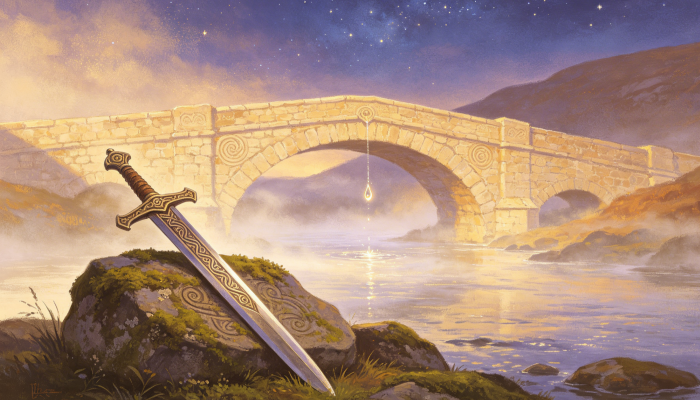
I have been in many shapes before I attained a congenial form: I have been a narrow blade of a sword; I have been a drop in the air; I have been a shining star; I have been a bridge for passing over. What am I?
It’s not an object. Think of someone, or something, that could claim all of these things at once.
Click to Reveal the Answer
The Bard Himself ✨
This is the voice of the Welsh poet Taliesin, boasting that his inspired soul has passed through every shape in creation.
The Bard Who Claimed to Be Everything
The riddle comes from a Welsh poem called Cad Goddeu, or The Battle of the Trees, preserved in the 14th-century Book of Taliesin. The voice belongs to Taliesin, a legendary bard said to have lived in the 6th century, though most scholars now think this particular poem was written centuries later by poets writing in his name. The “answer,” then, is the bard himself, or more precisely the poetic spirit that flows through him. The list of shapes is the speaker’s claim that he has been everywhere, seen everything, and now sings from a place of total experience.
A Tradition of Inspired Boasting
In the Welsh bardic tradition, this kind of boasting had a name. A true poet was called an awenydd, one filled with awen, the divine breath of inspiration. Awen was believed to flow like a wind through chosen poets, letting them speak with the voice of nature, history, and the gods. Shape-shifting verses were performance pieces, sometimes used in actual contests between bards at court, where poets traded boasts to prove who carried the deepest inspiration. Behind the legend stands a real social role: the bard was the memory of his people, paid to praise kings and curse enemies, and his authority depended on seeming to have lived through more than one lifetime.
Why the List Still Lands
What still moves a reader today is the list itself. A sword, a tear, a star, a bridge: these are not random images but a small tour of creation, from the violent to the tender to the immense to the useful. The poet is saying that nothing in the world is foreign to him because he has, in some sense, been all of it. It is the oldest argument an artist ever makes, that art is born from the willingness to dissolve into other things and come back changed. Fourteen centuries on, the riddle still asks every reader the same quiet question: how many shapes have you been?
Try Another Riddle?
My Garment Is Silent When I Tread the Earth — Daily Riddle